Last Updated on 16th March 2026 by Charlie Walsh
Kegel exercises aren’t just for women—they are one of the most effective ways men can strengthen the pelvic floor muscles, the group of muscles responsible for bladder control, bowel function, and sexual performance. By practicing pelvic floor exercises for men, you can improve urinary control, increase erection strength, support prostate health, and even enhance ejaculation control.
These discreet exercises for men require no equipment and can be done almost anywhere. The key is learning how to identify the correct muscles, performing controlled contractions, and building consistency through a daily pelvic floor exercise routine.
In this guide, you’ll learn:
- What the male pelvic floor actually is
- Why strengthening it matters for sexual and urinary health
- The science behind Kegel exercises for men
- How to identify and activate the correct muscles
- How pelvic floor training can complement male performance tools
Understanding the Male Pelvic Floor
Many men focus on visible muscles—the chest, arms, and abs—while ignoring one of the most important muscle groups in the body: the pelvic floor muscles.
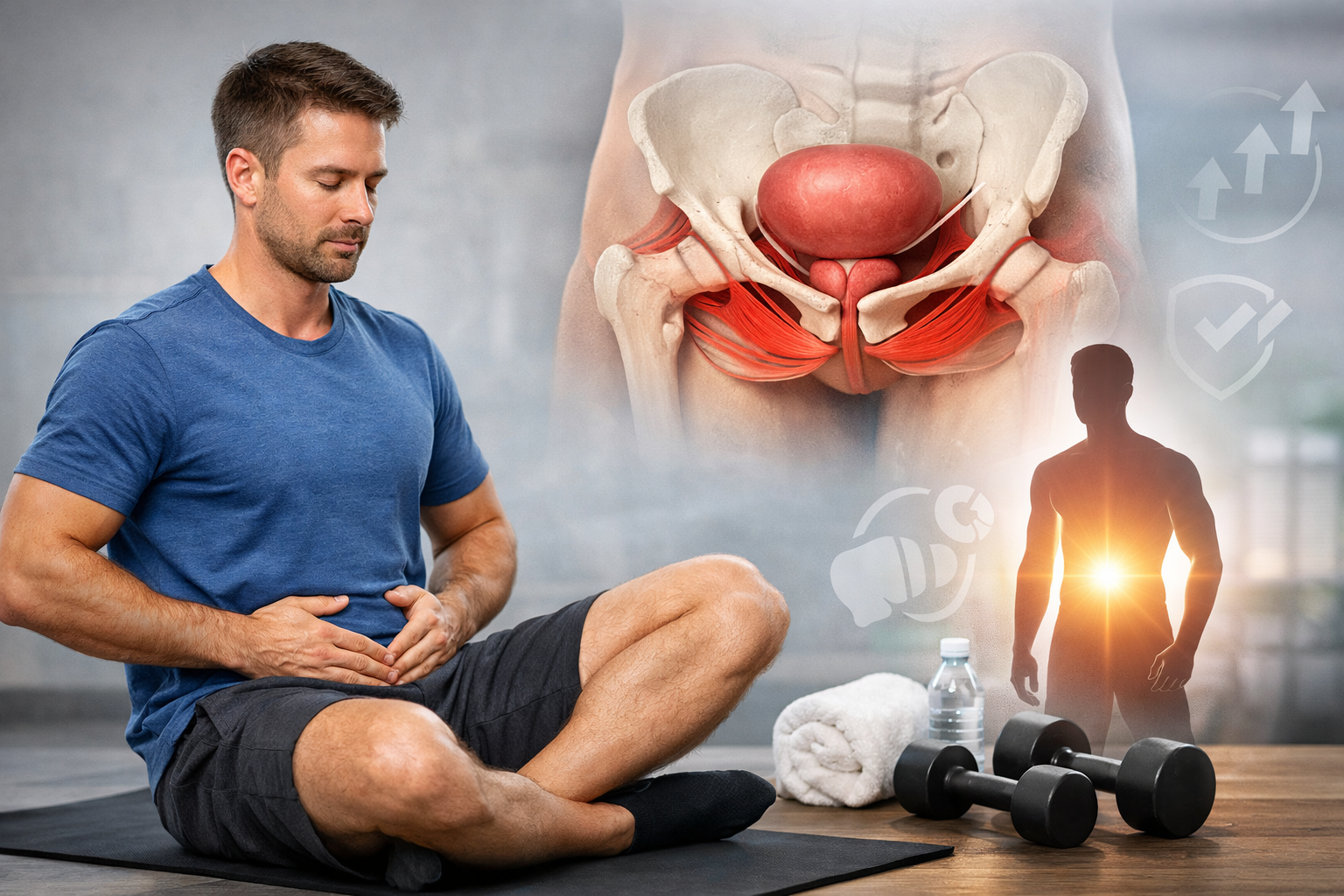
These muscles form a supportive hammock at the base of the pelvis, holding several critical organs in place.
What the Pelvic Floor Muscles Do
The male pelvic floor muscles play a vital role in several bodily functions:
- Bladder control and urinary continence
- Bowel control and digestive regulation
- Sexual performance, including erection strength
- Ejaculation control
- Support of pelvic organs such as the bladder and prostate
In short, these muscles act as the body’s hidden control center for male pelvic health.
When the pelvic floor becomes weak—often due to aging, surgery, or prolonged sitting—men may experience:
- urinary incontinence
- dribbling after urination
- erectile dysfunction (ED)
- reduced sexual performance
- pelvic muscle weakness
Strengthening the pelvic floor through pelvic floor muscle training directly addresses many of these problems.
The Anatomy Behind Male Kegel Exercises
To understand why these exercises work, it helps to look briefly at the underlying anatomy.
The pelvic floor is primarily made up of several muscles, including:
- Pubococcygeus (PC) muscle
- Levator ani muscles
- Muscles surrounding the urinary sphincter
- Supporting connective tissues forming the pelvic diaphragm
These muscles surround the base of the bladder and penis and help regulate urinary control and sexual function.
When you contract these muscles, you temporarily stop urine flow and stabilize the pelvic organs.
This is the core concept behind Kegel exercises for men—repeatedly contracting and relaxing these muscles builds strength and endurance.
Why Pelvic Floor Strength Matters for Men
Weak pelvic floor muscles can affect men in more ways than most realize. Many symptoms commonly associated with aging actually stem from pelvic floor dysfunction.
Strengthening the pelvic floor can help address several issues simultaneously.
1. Improved Bladder Control
One of the most immediate benefits of men’s pelvic floor exercises is improved bladder control.
Weak pelvic muscles can lead to:
- urine leakage
- bladder control problems
- nocturia (frequent nighttime urination)
- urinary hesitancy
By learning to contract pelvic floor muscles, men can regain control over the urinary sphincter, helping prevent leakage and improve urinary continence.
2. Stronger Erections
The pelvic floor plays a key role in erectile function.
During an erection, the pelvic muscles help trap blood in the penis. Stronger muscles mean better circulation and stronger erections.
Research has shown that pelvic floor muscle training can significantly improve erection strength in men experiencing mild to moderate erectile dysfunction.
Strengthening these muscles may improve:
- blood flow to the penis
- erection firmness
- stamina during intercourse
Many men also combine pelvic floor exercises with physical tools designed to support performance and circulation, such as the HydroXtreme Pump.
These devices use water-based pressure to enhance blood flow while training the surrounding tissue.
3. Better Ejaculation Control
Another major benefit of male Kegel exercises is improved ejaculation control.
Stronger pelvic muscles allow men to regulate the muscular contractions that occur during orgasm.
This can help with:
- premature ejaculation
- improved sexual endurance
- better control during climax
The result is greater confidence and improved overall sexual performance.
How to Find Your Pelvic Floor Muscles
Before starting a pelvic floor exercise routine, it’s essential to identify the correct muscles.
Many men accidentally engage the abdominal or glute muscles instead of the pelvic floor.
Fortunately, there are simple methods to locate the correct muscles.
The Stop Urine Flow Test
One of the easiest ways to identify the pelvic floor muscles is the stop urine flow test.
While urinating, try to briefly stop the stream.
The muscles you activate during this action are your pelvic floor muscles.
This test should only be used for identification—not as a regular exercise routine.
Once you know how to engage the muscles, you can begin practicing controlled pelvic muscle contractions outside the bathroom.
How to Perform Kegel Exercises for Men
Learning how to do Kegels for men correctly makes all the difference.
The goal is to tighten pelvic muscles, hold the contraction, and then relax them in a controlled cycle.
Basic Kegel Exercise Technique
- Sit or lie down comfortably
- Tighten the pelvic floor muscles
- Hold the contraction for 3–5 seconds
- Slowly relax pelvic floor muscles
- Repeat the movement
This hold and release contraction pattern is the foundation of effective pelvic floor muscle training.
Beginner Routine
A simple starting routine might look like this:
- 10 contractions per set
- 3 sets per day
- Gradually increase hold time to 10 seconds
These daily Kegel exercises improve pelvic muscle endurance over time.
Supporting Pelvic Health With Additional Tools
Although Kegel exercises are non-equipment pelvic exercises, some men incorporate performance tools alongside training.
For example, water-based pumps like the HydroMax Lander are designed to encourage healthy blood flow to the penis while strengthening surrounding tissues.
Unlike traditional air pumps, hydro pumps use water pressure, which many users find more comfortable and controlled.
Bathmate offers a range of devices that complement pelvic health training, all of which can be explored through the penis pump collection.
Building a Long-Term Pelvic Floor Training Habit
Consistency is what makes pelvic floor training effective.
Like any other muscle group, the pelvic floor becomes stronger through repetition.
Some men begin noticing improvements in male urinary health and sexual function within 4–6 weeks of regular training.
Over time, stronger pelvic muscles can help:
- prevent urine leakage
- improve bowel control
- strengthen core pelvic muscles
- enhance male core stability
And because Kegels are discreet, they can be performed almost anywhere—sitting at a desk, driving, or watching TV.
Do Kegels Work for Men?
One of the most common questions men ask is simple:
Do Kegels work for men?
The short answer is yes—and there is growing evidence supporting their effectiveness.
Pelvic floor muscle training is frequently recommended in urology health and pelvic health physiotherapy for conditions such as:
- urinary incontinence
- bladder control problems
- erectile dysfunction
- premature ejaculation
- prostate surgery recovery
By strengthening the pelvic muscles that surround the bladder and reproductive organs, men gain greater control over functions that depend on muscular support.
These muscles also contribute to male core stability, working alongside abdominal and lower back muscles to stabilize the body during movement.
Kegels for Erectile Dysfunction
For many men, pelvic floor weakness can contribute to erectile dysfunction (ED).
The pelvic floor muscles play a key role in maintaining erections because they help trap blood within the erectile tissues of the penis.
When these muscles are strong, they assist with:
- maintaining erection firmness
- sustaining blood flow to the penis
- improving erection duration
This is why pelvic floor exercises for men are often recommended as part of a natural approach to ED management.
Why Muscle Strength Improves Erections
Two pelvic muscles in particular play a critical role:
- Pubococcygeus (PC) muscle
- Bulbocavernosus muscle
These muscles contract during erection and ejaculation.
Stronger pelvic muscle contractions improve the body’s ability to maintain pressure within the erectile chambers.
Many men combine pelvic floor strengthening routines with circulation-support tools such as the Hydro7, which is designed to promote healthy blood flow and tissue expansion using controlled hydro pressure.
When combined with consistent pelvic muscle training, improved circulation can support overall male sexual function.
Kegels for Premature Ejaculation
Another area where pelvic floor strength makes a significant difference is ejaculation control.
Weak pelvic floor muscles may reduce a man’s ability to control the muscular contractions involved in orgasm.
Strengthening these muscles helps men develop better awareness and control of the pelvic region.
Benefits may include:
- improved sexual stamina
- stronger orgasm control
- better regulation of climax
A targeted pelvic floor exercise routine can therefore serve as a form of premature ejaculation exercise training.
Pelvic Floor Exercises After Prostate Surgery
Men who have undergone prostate surgery recovery often experience temporary issues with bladder control.
Procedures such as prostatectomy can weaken the muscles responsible for urinary continence.
This is why doctors frequently recommend Kegels after prostate surgery as part of prostatectomy rehabilitation.
Pelvic floor training may help:
- restore bladder control
- reduce urine leakage
- rebuild pelvic muscle endurance
These exercises are often part of a structured male continence therapy program overseen by medical professionals.
Signs Your Pelvic Floor May Be Weak
Not every man immediately realizes that pelvic floor weakness is the root of his symptoms.
However, several common indicators suggest that strengthening exercises may help.
Possible Symptoms of Pelvic Floor Dysfunction
- urine leakage when coughing or laughing
- dribbling after urination
- difficulty maintaining erections
- reduced sexual performance
- overactive bladder
- pelvic discomfort
Men experiencing these issues may benefit from pelvic rehabilitation exercises designed to restore strength and control.
Advanced Kegel Exercise Routine
Once you become comfortable with the basic contraction technique, you can expand your training with more structured exercises.
These routines build pelvic muscle endurance, allowing the muscles to sustain contractions for longer periods.
Endurance Training
- Contract pelvic floor muscles
- Hold for 10 seconds
- Relax for 10 seconds
- Repeat 10 times
This exercise strengthens the bladder support muscles and improves long-term control.
Quick Contractions
Fast contractions train the muscles responsible for sudden control during coughing, sneezing, or sexual activity.
- Squeeze pelvic floor muscles quickly
- Release immediately
- Repeat 15–20 times
These rapid pelvic muscle contractions improve reaction speed and muscle responsiveness.
Progressive Hold Training
Another effective exercise is gradual contraction.
- Slowly tighten pelvic muscles
- Increase intensity over several seconds
- Hold at maximum contraction
- Slowly release
This technique strengthens the entire pelvic diaphragm, promoting better coordination between pelvic muscle groups.
Common Mistakes Men Make With Kegels
Although Kegels appear simple, many beginners perform them incorrectly.
The most common mistake is engaging the wrong muscles.
Muscles That Should NOT Be Activated
Avoid tightening:
- abdominal muscles
- glutes
- thigh muscles
Only the pelvic floor muscles should contract during the exercise.
Another mistake is holding the breath.
Instead, breathe normally while performing each contraction.
How Often Should Men Do Kegels?
Consistency matters more than intensity.
Most experts recommend performing daily Kegel exercises as part of a long-term pelvic health routine.
Typical Training Frequency
- 3 exercise sessions per day
- 10–15 repetitions per set
- gradual increase in hold time
Over time, this strengthens the core pelvic muscles and improves both urinary and sexual health.
Supporting Your Routine With Performance Equipment
While Kegels strengthen the internal pelvic muscles, some men choose to complement their routine with external performance devices.
For example, the HydroXtreme Kit provides a complete system designed to support circulation and tissue conditioning.
These systems are often used alongside pelvic floor training to support:
- erection strength
- blood flow to the penis
- overall sexual confidence
Accessories that enhance comfort and usability can also be found through the Bathmate accessories collection.
Developing Long-Term Pelvic Strength
Just like weight training, pelvic floor training produces gradual improvements.
The key is consistency.
Over weeks and months, a structured pelvic floor strengthening routine can help:
- improve bladder control
- enhance male sexual health
- increase pelvic muscle endurance
- support prostate health
Men who integrate these exercises into their daily routine often find them becoming second nature.
They require no equipment, no gym membership, and only a few minutes per day.
Lifestyle Habits That Support Pelvic Floor Strength
Although pelvic floor muscle training is highly effective, everyday habits also play a role in maintaining pelvic health.
Weakness in the pelvic floor can develop gradually due to lifestyle factors such as prolonged sitting, inactivity, or excessive strain during lifting.
Improving these habits can help reinforce the benefits of men’s pelvic floor exercises.
Maintain a Healthy Core
The pelvic floor works together with the abdominal muscles and lower back to stabilize the body.
This muscular network helps maintain male core stability and supports the spine during movement.
Activities that help strengthen the core include:
- walking
- swimming
- resistance training
- mobility exercises
These activities support the levator ani muscles and the surrounding pelvic structures.
Avoid Excessive Straining
Straining during bowel movements or lifting heavy objects improperly can place pressure on the pelvic diaphragm.
Over time, this strain may weaken the bladder support muscles.
To reduce strain:
- maintain proper lifting technique
- stay hydrated
- eat a fiber-rich diet
- avoid holding your breath while lifting
These small adjustments can protect the pelvic floor from unnecessary stress.
Stay Consistent With Pelvic Floor Training
Consistency remains the most important factor in strengthening the pelvic floor.
Even a simple routine of daily Kegel exercises can lead to noticeable improvements.
Over time, these exercises may help:
- improve bowel control
- strengthen core pelvic muscles
- support male urinary health
- improve sexual performance
Because Kegels are non-equipment pelvic exercises, they can easily fit into daily routines without disrupting other activities.
Combining Pelvic Floor Training With Circulation Support
While Kegel exercises strengthen the muscles that support erections, circulation also plays a key role in erectile function.
Healthy blood flow is essential for achieving and maintaining strong erections.
Many men therefore combine exercises for men’s sexual health with circulation-support tools designed to enhance blood flow.
For example, advanced hydro pumps such as the HydroXtreme UltraMale Kit are designed to support expansion and circulation using water-based pressure.
These systems are engineered to work alongside the body’s natural physiology.
When combined with a strong pelvic floor, improved circulation may contribute to:
- stronger erection strength
- improved sexual confidence
- better overall sexual performance
Men interested in exploring a full range of performance tools can learn more at Bathmate Direct.
When Pelvic Floor Therapy May Be Needed
Although most men can benefit from Kegel exercises, some individuals may require additional guidance.
Men experiencing persistent symptoms of pelvic floor dysfunction may benefit from professional pelvic floor therapy.
Healthcare providers specializing in pelvic health physiotherapy may offer treatment for:
- severe urinary incontinence
- chronic pelvic pain
- ongoing bladder control problems
- recovery after pelvic surgery
These programs often include structured pelvic rehabilitation exercises designed to restore muscle coordination and endurance.
Building Pelvic Muscle Endurance Over Time
Just like any muscle group, the pelvic floor adapts to progressive training.
At first, the muscles may fatigue quickly, especially if they have been inactive for years.
However, consistent practice gradually builds pelvic muscle endurance, allowing the muscles to sustain longer contractions and provide better support for the pelvic organs.
Over time, stronger pelvic muscles help maintain:
- urinary continence
- sexual stamina
- pelvic stability
Men who stay consistent with their routine often report noticeable improvements within one to three months.
Creating a Sustainable Pelvic Floor Routine
The most effective pelvic floor routine is one that becomes part of daily life.
Rather than viewing Kegels as a chore, many men incorporate them into everyday moments.
Common opportunities include:
- sitting at a desk
- commuting
- watching television
- walking
These moments allow men to practice pelvic muscle contractions discreetly throughout the day.
Because the exercises require no equipment, they remain one of the simplest ways to maintain long-term male continence and pelvic strength.
Final Thoughts
The pelvic floor may be one of the most overlooked muscle groups in the male body, yet its impact on health and performance is substantial.
Regular pelvic floor exercises for men can help strengthen the muscles responsible for urinary control, bowel function, and sexual performance. Over time, these exercises support better male sexual function, stronger erections, and improved overall pelvic stability.
For men seeking to improve both pelvic strength and circulation, combining male Kegel exercises with supportive tools and healthy lifestyle habits can create a powerful foundation for long-term sexual wellness.
Ultimately, the greatest benefit of pelvic floor training is its simplicity. A few minutes of focused contractions each day can strengthen muscles that influence some of the most important functions in the body.
And with consistency, the results can extend far beyond the pelvic floor itself—supporting confidence, health, and performance for years to come.
Frequently Asked Questions About Kegels for Men
Below are answers to some of the most commonly asked questions about male pelvic floor training that were not covered in the main sections of the article.
1. How long does it take to see results from Kegel exercises for men?
Most men begin to notice improvements in bladder control and pelvic strength within 4 to 8 weeks of consistent practice. Sexual health benefits, such as improved erection strength or ejaculation control, may take several weeks to a few months depending on consistency and muscle condition.
Like any muscle training program, results depend on performing the exercises regularly and using proper technique.
2. Can you do too many Kegels?
Yes. Overtraining the pelvic floor can lead to muscle fatigue or tension.
While these exercises are beneficial, excessive contractions without proper relaxation can contribute to pelvic discomfort or tightness.
A balanced routine should include:
- controlled contractions
- full muscle relaxation
- moderate daily repetitions
Quality of contractions is more important than performing a large number of repetitions.
3. Are Kegels safe for men of all ages?
Yes. Kegel exercises are generally safe for men of all ages, from younger adults looking to improve performance to older men focusing on bladder control and prostate health.
However, men recovering from surgery or experiencing pelvic pain should consult a healthcare professional before beginning a new pelvic floor exercise routine.
4. Can Kegels increase penis size?
Kegel exercises themselves do not increase penis size. Their primary function is strengthening the pelvic floor muscles.
However, stronger pelvic muscles can improve erection firmness and blood retention, which may create the appearance of fuller erections.
5. Should men do Kegels while urinating?
Kegels should not be performed regularly while urinating.
Although the stop-urine technique is useful for identifying pelvic floor muscles, repeating the exercise during urination can interfere with normal bladder emptying and may increase the risk of urinary problems.
Instead, perform the exercises when the bladder is empty.
6. Can Kegels help with post-urination dribbling?
Yes. Post-urination dribbling is often caused by weak pelvic floor muscles.
Strengthening the muscles around the urethra can help men improve control and reduce residual urine leakage after finishing in the bathroom.
This is one of the most common reasons healthcare providers recommend pelvic floor exercises.
7. Are Kegels helpful for men who sit for long periods?
Men who sit for extended periods—such as office workers or drivers—may develop weaker pelvic muscles due to reduced movement and circulation.
Kegels are particularly beneficial in these cases because they can be performed while sitting, making them easy to incorporate into a sedentary workday.
8. Can Kegels improve orgasm intensity?
Many men report stronger and more intense orgasms after developing stronger pelvic floor muscles.
During climax, the pelvic muscles contract rhythmically. Improved muscle strength and coordination can make these contractions more powerful, which may enhance overall sexual satisfaction.
9. Do athletes or physically active men still need Kegels?
Even highly active men may have underdeveloped pelvic floor muscles.
Traditional strength training focuses on large muscle groups but often neglects the pelvic floor. Incorporating Kegels helps ensure balanced muscular support for the pelvis and can enhance stability during physical activities.
10. How do you know if you are doing Kegels correctly?
One of the easiest ways to determine proper technique is to monitor surrounding muscles.
When performed correctly:
- the abdomen remains relaxed
- the buttocks stay still
- breathing continues normally
You should feel a gentle lifting or tightening sensation in the pelvic region, rather than tension in the stomach or thighs.
If uncertainty remains, pelvic health specialists or physiotherapists can help confirm correct muscle engagement.